




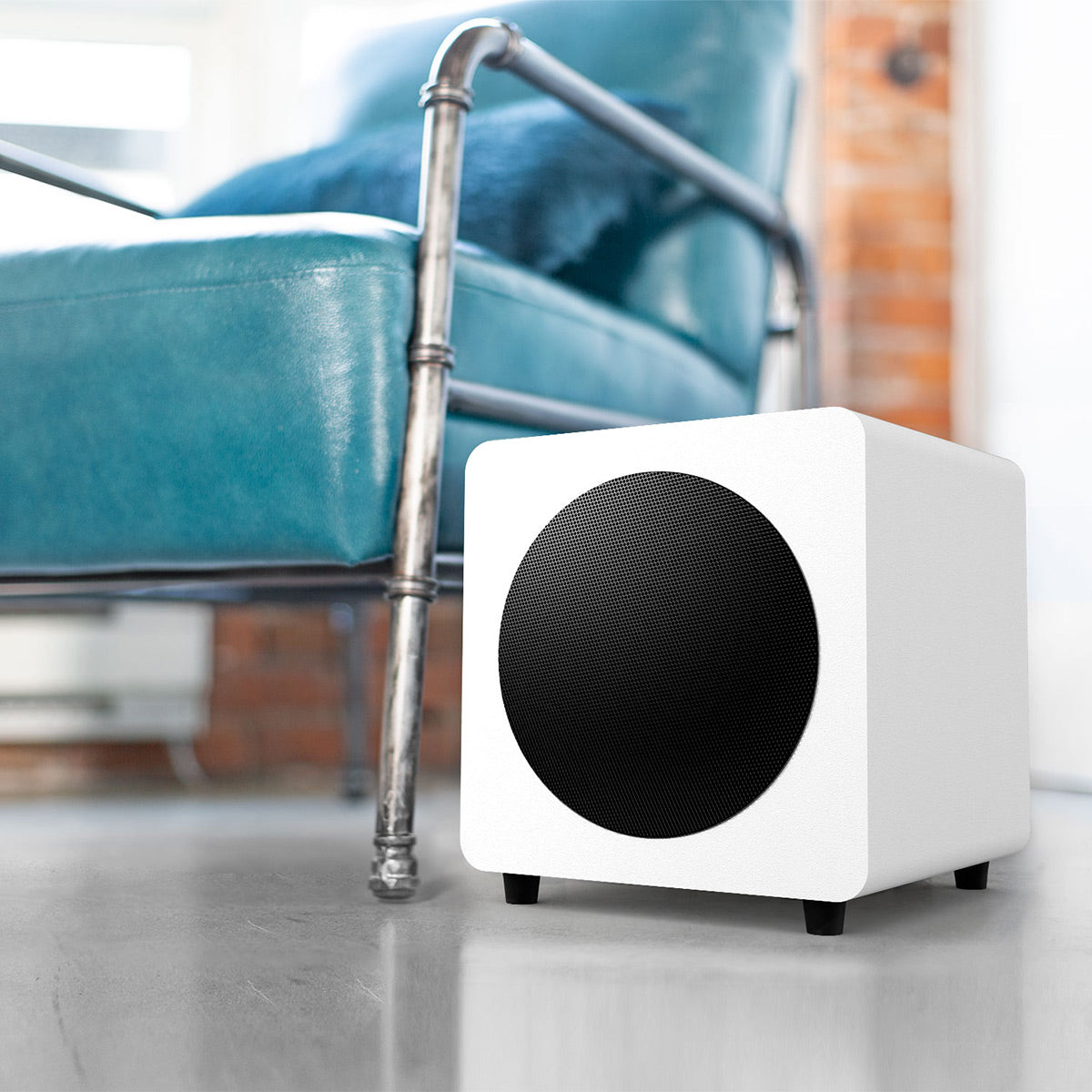


This Package Includes
- Kanto SUB8 8" Sealed Powered Subwoofer
- AudioQuest Jack Russell Subwoofer Cable - 13.12 ft. (4m)
Kanto SUB8 8-inch Sealed Powered Subwoofer
SUB8 is a sealed box front-firing subwoofer offering 250-Watts of powerful bass extension, perfect for music or home theater. A precise low-pass filter makes SUB8 a perfect match with any Kanto speaker, allowing you to dial in the perfect cutoff frequency. Its 8-inch paper-cone driver enables true sub-bass reproduction with low-end that has real weight. Phase adjustment, power saving auto-off and full L/R line level input round out this high-performance package.
Sealed Enclosure
Sealed subwoofers react to changes in audio more quickly than vented designs. Every bass note is reproduced accurately with little distortion allowing you to hear pure audio and not the subwoofers’ influence on the sound.
Durable Materials
All materials used are designed for years of worry-free longevity. Never worry about moving or placing items on sub8 as it can take the rigors of everyday life.
Compact Design
At roughly 11” in each direction, sub8 fits under desks or in the smallest of apartments where traditional home theatre subwoofers may dominate the space.
Stunning Looks
The simple, unfussy look of sub8 blends well into any decor and provides a cohesive look with Kanto speakers for unmatched aesthetics.
Easy Integration
The adjustable high-pass filter and phase switch lets you integrate sub8 into your audio system regardless of speakers being used ensuring you’re not leaving performance on the table.
AudioQuest Jack Russell Subwoofer Cable - 13.12 ft. (4m)
Connect amplifiers, receivers, soundbars, and AVRs to subwoofers with a purpose-built RCA cable designed for clean, reliable signal transfer. Jack Russell features Solid Long-Grain Copper (LGC) conductors to reduce distortion caused by grain boundaries, Foamed-Polyethylene insulation to maintain dynamic contrast, and a Metal-Layer Noise-Dissipation system that helps dissipate and drain high-frequency noise away from the signal path. The result is more naturally beautiful and detailed music, more intelligible dialogue, and thrilling sound effects for home theater and music systems.
Features
- Solid Long-Grain Copper (LGC) Conductors
- Foamed-Polyethylene (FPE) Insulation
- Metal-Layer Noise-Dissipation
- Cold-Welded, Gold-Plated Terminations
- Direction-Controlled Conductors
Solid Long-Grain Copper (LGC) Conductors
The surface quality is critical because a conductor can be considered as a rail-guide for both the electric fields within a conductor and for the magnetic fields outside the conductor. High-purity LGC minimizes distortion caused by grain boundaries and maximizes linear RF Noise-Dissipation.
Foamed-Polyethylene (FPE) Insulation
Any solid material adjacent to a conductor is part of an imperfect circuit and absorbs energy. Some of this energy is stored and then released as distortion. Because air absorbs next to no energy and Polyethylene is low-loss and has a benign distortion profile, Foamed-PE, with its high air content, causes much less of the out-of-focus effect common to other materials.
Metal-Layer Noise-Dissipation
It’s easy to accomplish 100% shield coverage. Preventing captured radio-frequency interference from modulating the equipment’s ground reference requires AQ’s Noise-Dissipation. Traditional shield systems typically absorb and then drain noise/RF energy to component ground, modulating and distorting the critical reference ground plane, which in turn causes a distortion of the signal. Noise-Dissipation “shields the shield,” absorbing and reflecting most of this noise/RF energy before it reaches the layer attached to ground.
Cold-Welded, Gold-Plated Terminations
Instead of solder, the process employs a high-pressure technique. Because the ground shells are stamped instead of machined, the metal used can be chosen for low distortion instead of machinability.
Direction-Controlled Conductors
All drawn metal strands or conductors have a non-symmetrical, and therefore directional, grain structure. AudioQuest controls the resulting RF impedance variation so that noise is drained away from where it will cause distortion.


